The testimony of family and friends in Noland Veal’s 1908 Civil War Navy pension file centered around establishing his birth year as 1845, thus allowing him to receive his pension. Other testimonies within the pension file give us more insight into his life, his family, and the enslaved communities in the Mississippi River Valley during the time of the Civil War.
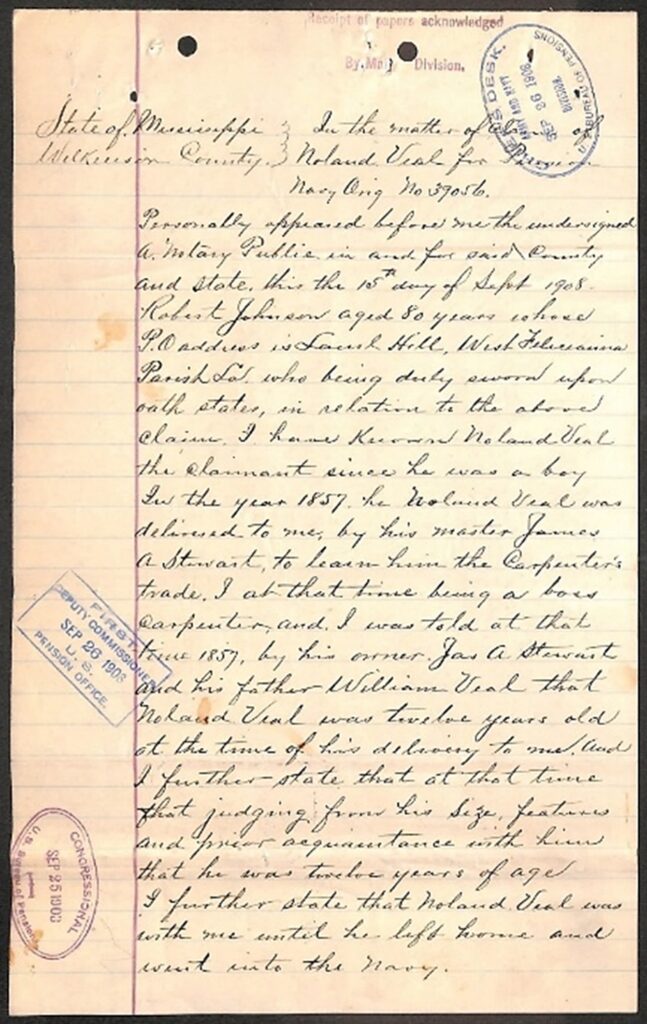
Testimony of Robert Johnson, Given 15 September 1908, Woodville, Miss.
Personally appeared before me the undersigned a Notary Public in and for said County and State, this the 15th day of Sept 1908. Robert Johnson aged 80 years whose P.O. address is Laurel Hill, West Feliciana Parish, La. Who being duly sworn upon oath states, in relation to the above claim.
“I have known Noland Veal the claimant since he was a boy. In the year 1857, he Noland Veal was delivered to me, by his master James A. Stewart, to learn him the carpenter’s trade. I at that time being a boss carpenter, and, I was told at that time 1857, by his owner Jas A Stewart and his father William Veal that Noland Veal was twelve years old at the time of his delivery to me. And I further state that at that time that judging from his size, features, and prior acquaintance with him that he was twelve years of age. I further state that Noland Veal was with me until he left home and went into the Navy. And I further state that I have no interest in the presentation of the claim.”
Robert Johnson was born into slavery in Missouri around 1823. In 1908, at age 34, he testified that Noland Veal was apprenticed to him in 1857. It is not clear how Johnson pinpointed that specific year, and it remains uncertain how much time passed between Noland’s disappearance from the charcoal pile and his sudden appearance aboard the gunboat Kenwood. But, if he apprenticed with Johnson for five years, beginning at 12, and remained an additional year or two, he would have left Johnson in around 1864.
Testimony of Robert Johnson, Given 14 December 1908, Woodville, Miss.
Personally appeared before the undersigned Clerk of the Circuit Court in and for Wilkinson County State of Mississippi, Robert Johnson. Known to me as such, who being duly sworn testified as follows (the questions being asked by James Stewart McGehee, now of St Louis, formerly of Wilkinson County, Miss. and the answers given by the said Robert Johnson.)
Question: Please state your name, age, and Post Office
Answer: “My name is Robert Johnson. About 80 years of age. Carpenter by trade. Post Office Laurel Hill, Louisiana.”
Question: Now without getting someone to help you count it, please just state in your own way such facts as you remember regarding the early life of Noland Veal. If you prefer, begin at the last and state it backwards. When did he leave your employ?
Answer: “During the War between the North and South on a certain Saturday I was preparing a kiln of charcoal and Noland Veal was assisting me. On that day we got the kiln covered with leaves and threw on some dirt. On Monday morning when I called for my helpers to finish it Noland Veal had disappeared. I understood and he confirmed this to me several years afterwards, that he had run away to join the Yankee Army. I did not see him again until peace was declared.
Question: Now can you name anything that happened about that time?
Answer: Yes, when Noland Veal ran away the Yankee gunboats had just come onto the Mississippi River. The Yankee troops had not come up into the country at all then. The troops were all still on gunboats.”
Question: How many years did Noland Veal work with you at the carpenter’s trade?
Answer: “He was apprenticed to me for the term of five years and he served out his full term, he then remained with me longer, about one or two years as near as I can remember.
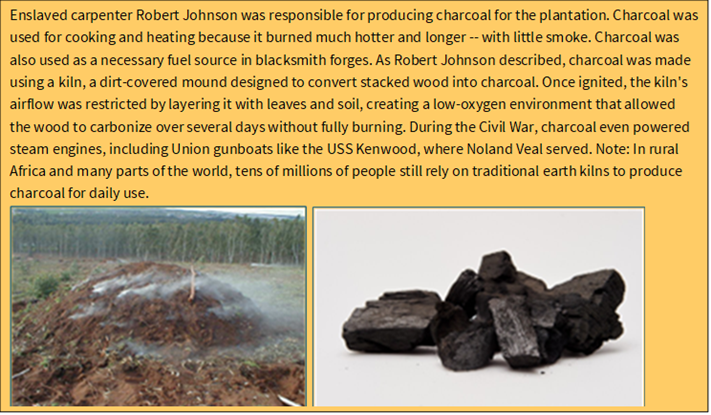
2. Charcoal: https://commons.wikimedia.org/wiki/File:Charcoal_9.jpg
Robert Johnson testified, “Saturday I was preparing a kiln of charcoal and Noland Veal was assisting me. …On Monday morning when I called for my helpers to finish it, Noland Veal had disappeared.” Naval records confirm that Noland enlisted on the USS Kenwood on Wednesday, March 2, 1864—just two days later, assuming he fled and enlisted within the same week.
It would have taken time to make his escape; saying farewell to family and friends, gathering supplies, and completing the 40-mile dangerous trek from Holly Grove Plantation to Bayou Sara. Noland enlisted alongside others from Holly Grove and the surrounding Woodville area, pointing to a deliberate and coordinated plan to join the Union fighting forces. According to Johnson, “the Yankee gunboats had just come onto the Mississippi River. The Union troops had not come up into the country at all then. The troops were all still on gunboats.” The escape route— Southwest through the woods and swampy territory—was timed with a knowledge of the arrival of the Kenwood at the Union occupied port of Bayou Sara–just below St. Francisville, Louisiana, on March 2, 1864.
At just twelve years old, Noland Veal was selected to apprentice as a carpenter—a skilled and respected craft within the plantation and community that may have shielded him from the brutal labor of the Mississippi cotton fields. Under Robert Johnson’s instruction, he spent seven years learning his craft and gaining knowledge from Johnson far beyond carpentry. Despite the seeming benefits of being in this position, Noland chose to flee in 1864, at around the age of seventeen, taking with him his hard-earned skills to enlist in the Union Navy and fight for his freedom.
© 2025 Alvin D. Blakes. All rights reserved.
Next: Black Sailors on the USS Kenwood

Yeabo Bob! I
Always good to hear from you Ser.
Pension files are so interesting.
Yes they are. And this is a really good one–168 pages with really good testimonies.
Good evening Cousin. An interesting read as always. I commend the courage of Mr. Veal and I am reminded how in those days, how others could speak for you and make a significant impact for you.
Thanks Jackie. I agree with you. And in this case Robert Johnson is speaking himself and Noland Veal into the history books.
Alvin, young Noland Veal’s story is interesting already, let alone adding in the Boss Carpenter’s testimonies re: his apprenticeship. And the Boss’ blacksmithing skills (that he probably learned from African parents) reminds me that the West African blacksmith was vital to various societies, honored, and feared since c.3360 years prior to Veal running off to the Kenwood and leaving charcoal dust behind. The pension files you find are amazing!
Thanks for reading and commenting. I am particularly interested in the enslaved blacksmiths and carpenters and how they might connect back to West and Central Africa. I had a blacksmith in my family named Abraham Blake (b.1839) that I briefly mentioned; see https://almostdisappeared.com/black-families-of-edgefield-plantation-woodville-mississippi-part-9/. He has a much bigger story I am working on.
This article read like a book with a cliffhanger. Alvin, how much longer do we have to wait for the book, “The Ventures of the Valiant, Vibrant Veals?”
While and after reading this article, I wondered when and if Noland put his carpenter skills to use. Did he work with coal on the Kenwood? Did he become a blacksmith or carpenter post-Civil War? Did his children follow in his footsteps?
Hey Vernita. Thanks for the comments and questions. I’m working on some answers for you.
Great history!
Thanks