After the surrender of Vicksburg and Port Hudson in July 1863, the Union Navy moved quickly to split the confederacy by cutting off Texas, Arkansas, and parts of Louisiana. Using squadrons of gunboats, the Navy blockaded the Mississippi River and divided it into operational districts, each protecting key ports such as New Orleans, Baton Rouge, Port Hudson, Bayou Sara, Natchez, Vicksburg, Greenville, Memphis, and as far north as Cairo, Illinois. The First district extended from New Orleans to Donaldsonville, Louisiana. The Second district covered the winding stretch of the river from Donaldsonville to Morganza. One of the gunboats assigned to patrol the second district was the USS Gunboat Kenwood #14. The Naval History and Heritage Command – Dictionary of American Naval Fighting Ships describes the Kenwood as a tin-clad, stern-wheel “steamer” purchased in Cincinnati, Ohio on July 15, 1853. Armed with two 32-pound bow guns and four 24-pound broadside howitzers, the Kenwood was a wood-burning vessel built for speed and maneuverability up-and-down the muddy “brown water” of the Mississippi River. The gunboat, when in full fighting mode, had a crew of around fifty sailors.
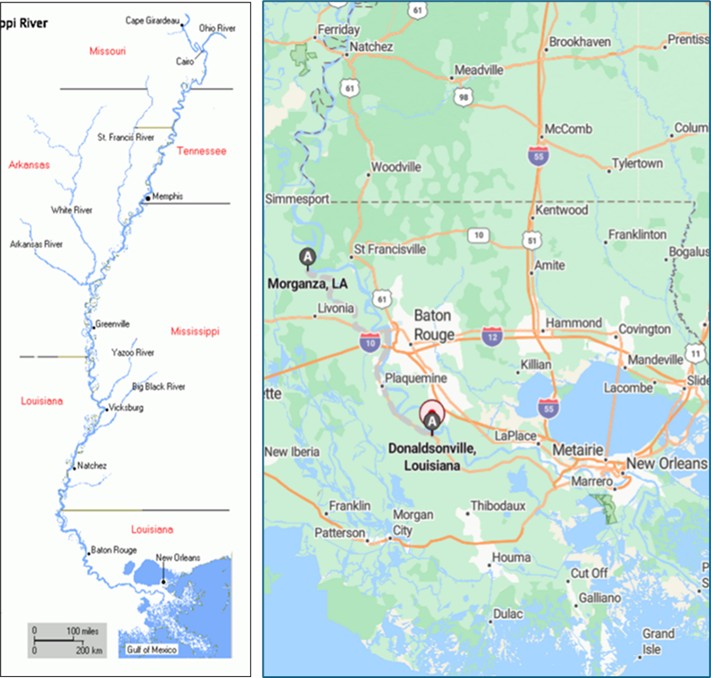
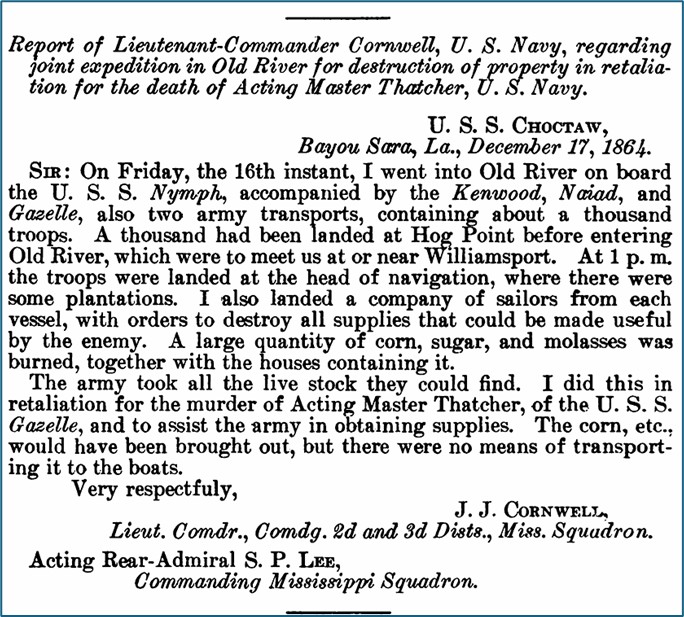
The Kenwood initially operated on the Arkansas River near Fort Pillow and later joined the joint Army-Navy expedition that captured Yazoo City, Mississippi, in July 1863. By August 1863 Kenwood was deployed to Port Hudson, Louisiana, then served as a convoy and patrol gunboat at Baton Rouge, Louisiana until February 1865. In the pension file of Noland Veal Robert Johnson testified “when Noland Veal ran away the Yankee gunboats had just come onto the Mississippi River. The Yankee troops had not come up into the country at all then. The troops were all still on gunboats.” This situation changed quickly as the Union Army transported thousands of soldiers up and down the Mississippi River, moving onto plantations throughout the valley and bringing freedom to enslaved populations.
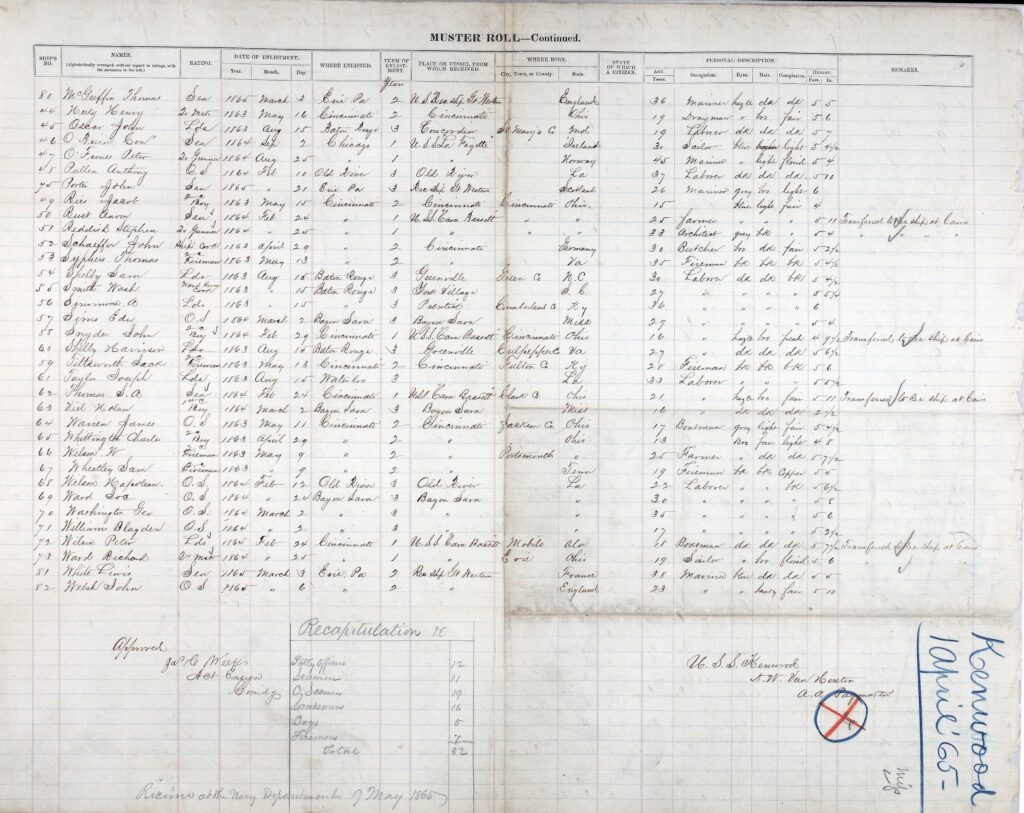
Muster Rolls: List of Names Aboard the Kenwood
On May 31, 1863, Kenwood departed Cincinnati with a crew of thirty-five sailors. These men, recruited from Ohio, and other parts of the United States and Europe, had signed two-year enlistments and brought prior naval experience. On August 15, while stationed in Baton Rouge, the Kenwood added fifteen men listed as “contraband”—formerly enslaved men enlisted into naval service. With them, the crew numbered forty-five. (Note: Nelson Jones’ name appears later under the August 15 enlistment date, but he was transported to the Naval hospital on September 19, 1863, and was not a member of the crew. His descendants should look for him there.)
On March 2, 1864, the Kenwood stopped at Bayou Sara, Louisiana, a port town below St. Francisville to enlist more crew members. That day, eleven enslaved Black men from Wilkinson County enlisted: William Bell, Sterling Dumars, Washington Farrar, Andrew Hayden, Charles Jones, Willis Martin, Edward Sims, Richmond Viel, Nolan Viel, George Washington, and William Blayden. Sixteen-year-old Nolan Viel (Noland Veal), signed on as a powder boy, a dangerous but vital job of carrying gunpowder from the ship’s magazines to the cannons.
By the end the war, the Kenwood’s final muster roll listed fifty-two men who were discharged August 3-5, 1865, at Mound City, Illinois. Mound City was a major Union naval base with shipbuilding and repair facilities, a naval hospital, and later a national cemetery. Some sailors transferred to other vessels and continued their service. Three men from the Kenwood, including sixteen-year-old Noland Veal, were transferred to the Red Rover, the Navy’s floating hospital ship, for treatment of syphilis infection. He was treated and discharged from service on August 29, 1865.
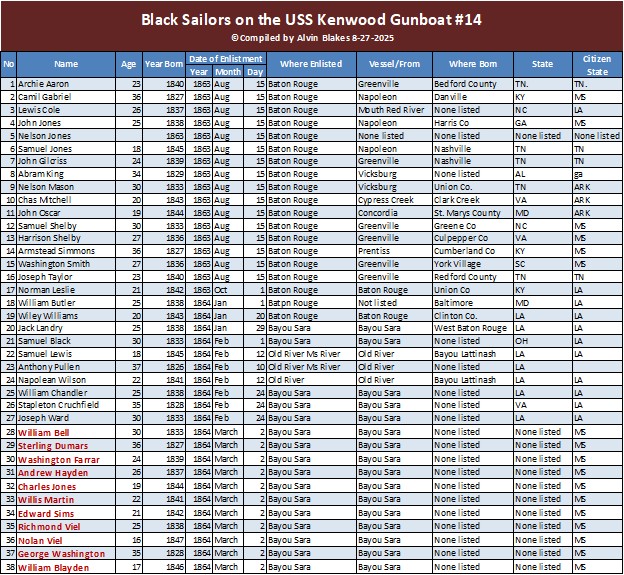
Across the Union Navy, it is estimated that Black sailors made up roughly 20% of crews. On the Kenwood, that proportion was closer to 50%. By studying the life of Noland Veal, we have learned how the young boys and men escaped plantations along the Mississippi river and joined the Navy. Many ran away in groups to the nearest Union-controlled ports along the river. After the war, Noland returned to Woodville, Mississippi, where he lived near his former mentor, carpenter Robert Johnson.
Next: Noland Veal Returns
Mr. Blakes, another very detailed and insightful offering from you! I look forward to your postings because I know that it will be enlightening. Keep giving us these powerful stories of your ancestors lives. If you ever offer seminars or webinars on your “process” in researching and documenting your subjects, I will be an attendee! Continued success in your efforts!
Wow! This very good to identify African descent Union Navy Freedom fighters of the Mississippi River Valley during civil war! s ya know the Navy did it segregate sailors like the Union Army did, thus it is most difficult for determining the racial types of Union sailors on the official military records. Every African descent sailor that becomes known helps to build the data based on “Black sailors in the Union Navy, who deserves to be remembered and honored or statures like U. S. Colored Troops!
Hey Sir. We learn more every day we work. By researching gunboat names and locations along the Mississippi River and perusing the muster rolls to see where the person enlisted and where he was born, we can find many of the Black sailors.
Very interesting!